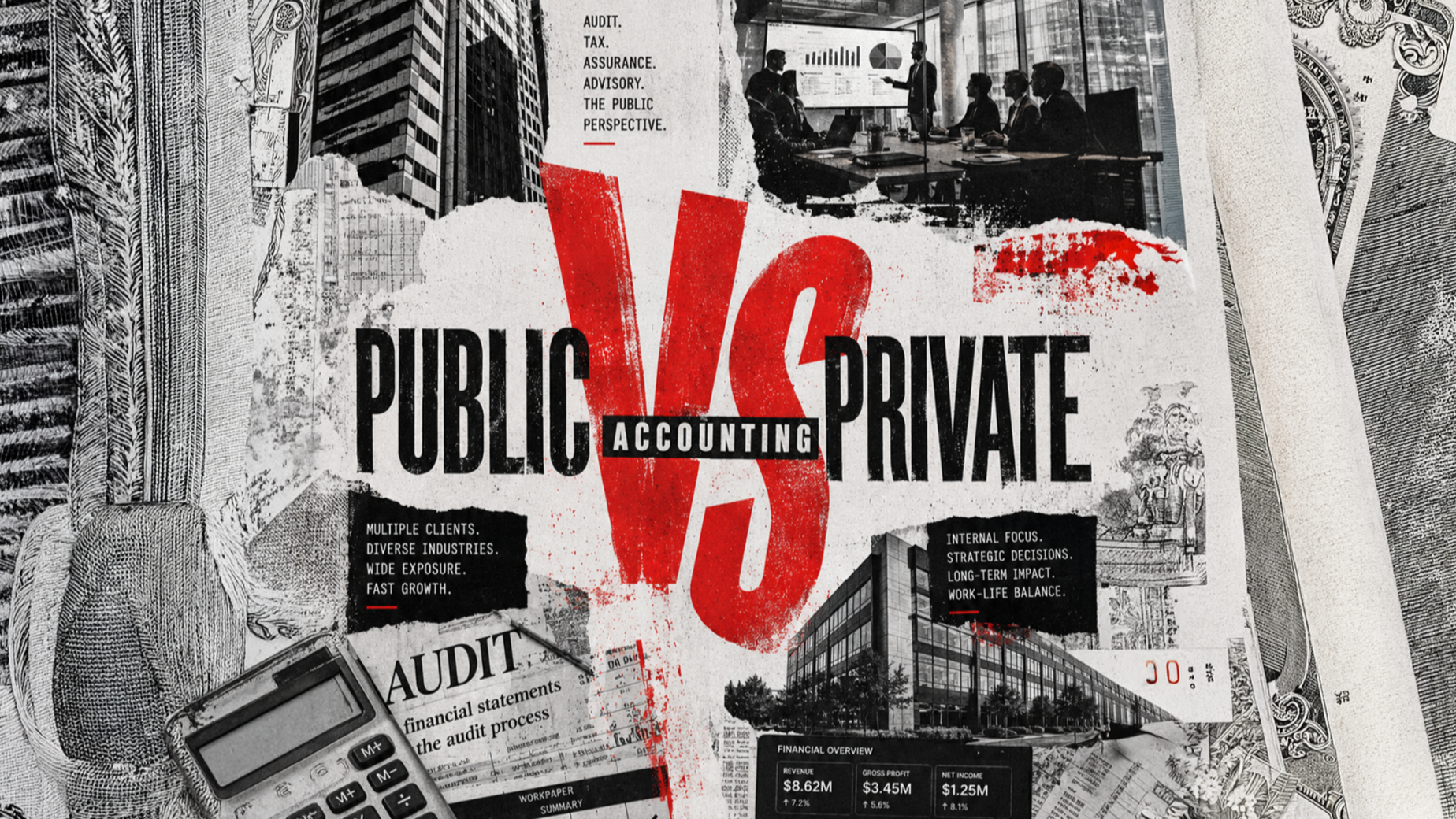
Public and private accounting lead to genuinely different careers. The work feels different, the pressure compounds differently, and the long-term opportunities diverge faster than most people expect. The gap in hours, compensation, and career trajectory between the two paths is larger than it looks from the outside.
Key Takeaways:
The Work Is Fundamentally Different: Public accountants serve multiple external clients across industries. Private accountants manage the finances of one organization from the inside. That difference shapes everything else, including what skills you build, how fast, and how transferable they are.
Compensation Shifts at the Mid-Career Level: Public accounting tends to pay more in the first few years. By the senior accountant, manager, and controller level, private accounting often surpasses it, especially when total comp including bonus and equity is factored in. Controller roles in 2026 range from $120,000 to over $200,000 at larger organizations.
Hours Are More Predictable in Private, Not Necessarily Fewer: Public accounting has unpredictable peaks tied to client deadlines. Private accounting has its own busy cycles around close, audit prep, and year-end, but you generally have more visibility into when they are coming.
The Leadership Tracks Diverge Significantly: Public accounting leads toward manager, director, and a partner track fewer than five percent reach. Private accounting leads toward controller and CFO, which is where the majority of senior finance leaders end up.
Public and private accounting can look similar from the outside. Both require the same foundational skills, the same credentials, and often the same degree. But the careers themselves are structured differently, the day-to-day work feels different, and the careers they produce ten years in can look nothing alike.
At some point in most accounting careers, the question starts becoming harder to ignore. Sometimes it comes after talking with someone who went a different direction and seems genuinely happier. Sometimes it is just the realization that the career you originally chose and the life you actually want may not point in the same direction anymore.
How the Work Differs
The hours reputation in public accounting is not exaggerated. Busy season is real, and sixty to eighty hour weeks during tax and audit cycles are common enough that most people in public accounting just accept them as part of the deal. The rest of the year is more manageable, but the unpredictability never fully goes away. When a client engagement accelerates or a deadline shifts, your schedule moves with it whether you planned for it or not.
Private accounting has its own version of this. Month-end close, year-end reporting, and audit prep cycles create legitimate crunch periods. Anyone who tells you private accounting is a forty hour per week job has not worked at a lean team inside a fast-growing company. That can be just as demanding as public at certain points in the year.
The real difference is visibility. In private accounting you generally know when the peaks are coming. You can plan around them, staff for them, and manage your workload accordingly. In public accounting the timeline is often dictated by the client, and that unpredictability adds a layer of stress that the hour count alone does not capture.
Private accounting tends to be more predictable. That does not always mean fewer hours, but it usually means more control over them.
How Hours Compare in Public vs Private Accounting
The hours reputation in public accounting is not exaggerated. Busy season is real, and sixty to eighty hour weeks during tax and audit cycles are common enough that most people in public accounting just accept them as part of the deal. The rest of the year is more manageable, but the unpredictability never fully goes away. When a client engagement accelerates or a deadline shifts, your schedule moves with it whether you planned for it or not.
Private accounting has its own version of this. Month-end close, year-end reporting, and audit prep cycles create legitimate crunch periods. Anyone who tells you private accounting is a forty hour per week job has not worked at a lean team inside a fast-growing company. That can be just as demanding as public at certain points in the year.
The real difference is visibility. In private accounting you generally know when the peaks are coming. You can plan around them, staff for them, and manage your workload accordingly. In public accounting the timeline is often dictated by the client, and that unpredictability adds a layer of stress that the hour count alone does not capture.
Private accounting tends to be more predictable. That does not always mean fewer hours, but it usually means more control over them.
Public vs Private Accounting Compensation
The old assumption that public accounting always pays better is no longer reliable, and the gap closes faster than most people expect.
Early in your career, public accounting firms offer competitive base salaries with structured progression tied to licensure. The CPA credential is factored into compensation expectations from the start, and the trajectory is clear and predictable.
The picture shifts significantly at the mid-career level. Private accounting roles at the senior accountant, manager, and controller level often offer total compensation packages that exceed what the equivalent stage looks like in public accounting, especially once bonus and equity are included. That gap is most pronounced at mid-market and larger companies where variable compensation is standard rather than exceptional. Controller compensation in 2026 runs from roughly $120,000 to well over $200,000 at larger organizations, with bonus structures that public accounting at the same experience level rarely matches.
Long term, the CFO track represents the highest earning potential in the profession. Mid-tier CFO total compensation averages around $270,000 with significantly more at enterprise organizations. That path runs through private accounting leadership for most people who reach it.
Private roles also tend to offer stronger benefits, better retirement contributions, and more predictable year-over-year growth than the bonus-dependent structures common at public firms.
Where Each Path Takes You
The Bureau of Labor Statistics projects accounting employment to grow five percent through 2034, with roughly 124,200 openings per year. Demand is not the issue in either world. The question is where your specific experience positions you as you move up.
If you have spent the last several years in public accounting, you are sitting on a foundation that private employers actively want. The technical depth, the multi-industry exposure, and the audit or tax experience you have built translates directly into corporate accounting, FP&A, and financial reporting roles at the senior level. The public accounting leadership track is structured and the partner level is lucrative, but fewer than five percent of associates get there. Most people who stay long enough to be honest with themselves already know which side of that percentage they are on.
If you are in private accounting, the trajectory is less about climbing a defined ladder and more about the scope of what you own and influence over time. The professionals who reach CFO and senior finance leadership from the corporate side typically got there by going deep inside industries they understood well, building cross-functional credibility, and taking on increasing ownership of financial outcomes rather than just reporting on them. The controller-to-CFO path is real and it is well compensated. The 2026 Accounting Salary Landscape breaks down what those roles are paying right now.
"Whether candidates are looking for a public accounting or industry position, they should understand that they're only as strong as their foundation. Public accounting typically provides more variety in terms of clients and situations and therefore a wider knowledge base. Industry roles provide the luxury of being able to focus on one company and its processes and needs. I am seeing a background in public accounting (and even the CPA license) being highly valued when filling industry positions."

The CPA: Does It Matter More in One World Than the Other?
In public accounting, the CPA is essentially non-negotiable past the staff level. Firms have structured timelines around licensure and it directly affects your progression to manager and beyond. If you are in public accounting and not pursuing it, you are limiting your path in a way that is hard to work around.
In private accounting the credential carries real weight but with more flexibility around it. Senior roles, particularly controller and above, frequently list the CPA as required or strongly preferred. It signals technical rigor and earns a consistent salary premium. According to the AICPA's 2025 Trends Report, certified professionals command ten to fifteen percent more than non-certified peers at equivalent experience levels.
That said, there are meaningful senior finance roles in corporate environments, particularly in FP&A and finance business partner positions, where the analytical and strategic work is weighted more heavily than technical compliance. The CPA matters in both worlds. It just matters differently.
How to Think About the Choice
The question is not which path is objectively better. It is which one fits how you want to work and where you want to end up.
| Category | Public accounting | Private accounting |
|---|---|---|
| Work style | Client-facing, multiple engagements | Internal operations, one organization |
| Hours | Less predictable, peak-heavy | More predictable, still demanding |
| Career growth | Fast technical development | Deep organizational expertise |
| Compensation | Stronger base early career | Stronger total comp long term |
| Variety | High across many industries | Lower, one company focus |
| Leadership path | Manager, Director, Partner track | Controller, CFO track |
Public accounting gives you breadth, technical credibility, and exposure to a wide range of industries and business models. That foundation is genuinely hard to build any other way and it carries real market value regardless of where your career goes next.
Private accounting gives you depth, organizational context, and a more direct path toward senior finance leadership inside a business. For professionals who want to understand one industry deeply and grow into a controller or CFO role, it is not the slower path. It is often the more deliberate one.
Many accounting professionals spend time in both worlds over the course of their careers. The paths are not mutually exclusive and the experience from one tends to make you better at the other. What matters is being honest about where you are now, what you actually want from the next ten years, and whether the path you are on is still pointed in that direction.
Begin Your Next Step Forward.
The Agency Recruiting places accounting and finance professionals across industries nationwide. Whether you are weighing your options or ready to make a move, contact us to learn what is available in today's market.